

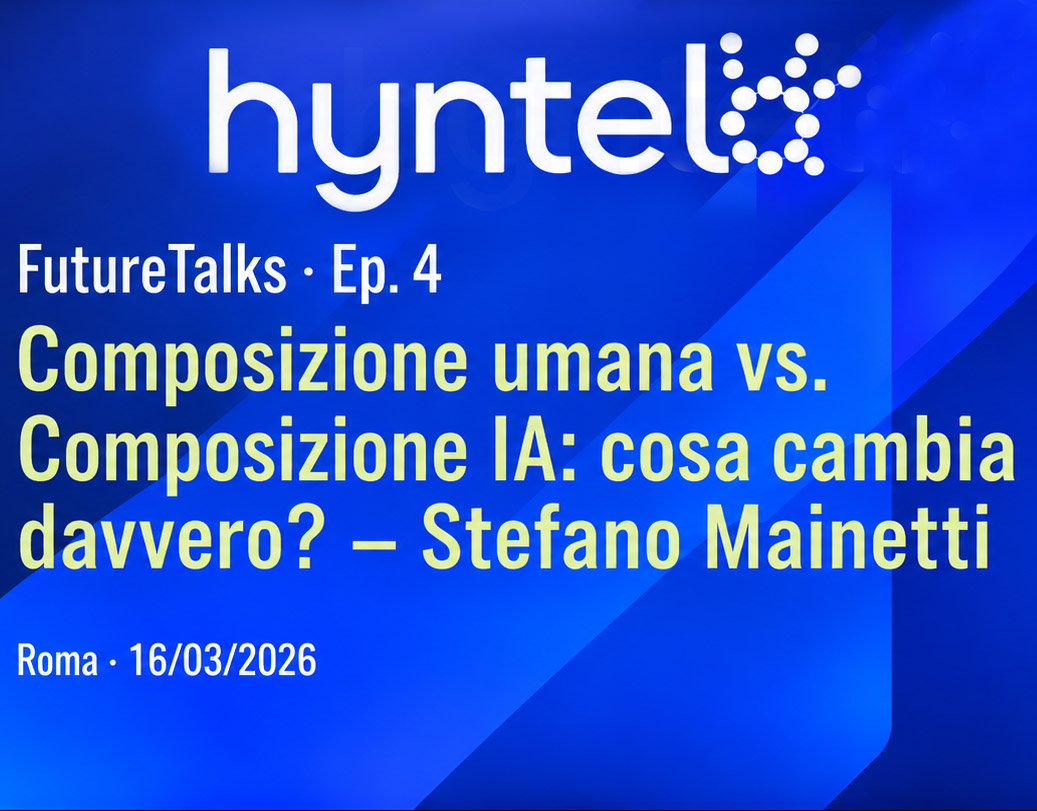
Human Composition vs. AI
On September 16 2026, the relationship between human creativity and Generative Artificial Intelligence was at the heart of a session featuring Stefano Mainetti at the Future Talks organized by Hyntelo, a company specializing in technological innovation and the development of advanced Artificial Intelligence solutions.
Through a combination of theoretical reflections, technological insights, listening sessions and practical demonstrations, Mainetti explored the transformations that Generative Artificial Intelligence is bringing to the world of music composition, focusing on new expressive possibilities and the artistic, cultural and professional implications of this evolution.
Long engaged in researching and experimenting with technologies applied to music, Mainetti regards Artificial Intelligence not merely as a production tool, but as a new field of creative exploration, capable of challenging and expanding the traditional boundaries of the compositional process.
A central aspect of his work is the exploration of the relationship between artistic intention and the unpredictability of generative systems: a dialogue in which the composer retains responsibility for aesthetic decisions while remaining open to sonic possibilities that may emerge through interaction with the machine.
During the session, Mainetti presented a particularly significant musical experiment: a piece conceived to tell, through music, the story of the evolution of trains, from the steam locomotives of the American Wild West to Italy’s modern Frecciarossa high-speed trains.
The narrative concept, musical direction, opening guitar parts and initial passage had all been conceived by the composer. During the generative process, however, the AI system introduced an unexpected element: a harmonica. This unanticipated yet musically coherent contribution provided an opportunity to reflect on one of the most intriguing aspects of collaboration between humans and Artificial Intelligence.
The unexpected can become a creative resource, provided there is an artistic sensibility capable of recognizing its value.
Mainetti also illustrated some of the fundamental principles underlying generative models, explaining how certain systems can begin with a distribution of noise and progressively transform it into recognizable musical content.
From this perspective, intriguing parallels emerge with the composer’s work: both processes may involve structures, rules, relationships and probabilities. Yet a fundamental distinction remains between generating possibilities and assigning artistic meaning to them.
An Artificial Intelligence system can produce numerous musically plausible solutions; it is the composer, however, who determines which of them fulfills a specific expressive intention, which deserves further development and which should be discarded.
The act of choosing, therefore, is not simply a matter of selection, but an integral part of artistic authorship.
The session forms part of Stefano Mainetti’s broader research into Generative Artificial Intelligence applied to composition, orchestration and music production, a field he approaches with the experience of a composer and the curiosity of a researcher exploring the evolution of creative languages and tools.
His approach goes beyond assessing the technical capabilities of emerging systems, focusing above all on the implications these technologies may have for the role of the composer, the identity of a musical work and the future of musical creativity.
From this perspective, Artificial Intelligence does not necessarily represent an alternative to human creativity. Instead, it can become a creative partner in the artistic process: a tool capable of suggesting unexpected directions, raising new questions and expanding the range of compositional possibilities.
The value of a musical work, however, lies not merely in what technology can generate, but in the vision, sensitivity and decisions of the person who uses it.
Hyntelo’s Future Talks thus provided an opportunity for dialogue between musical culture and technological innovation, offering a concrete reflection on one of the most significant transformations in today’s creative landscape.
For Stefano Mainetti, this dialogue represents part of an ongoing artistic exploration in which compositional tradition, experimentation and emerging technologies converge, while preserving the central role of human expression.